
Brand & Digital Strategy
How to Build a Strong Digital Presence That Turns Attention Into Trust
Learn how to build a strong digital presence that earns trust, improves visibility, and turns online attention into qualified business enquiries and leads.
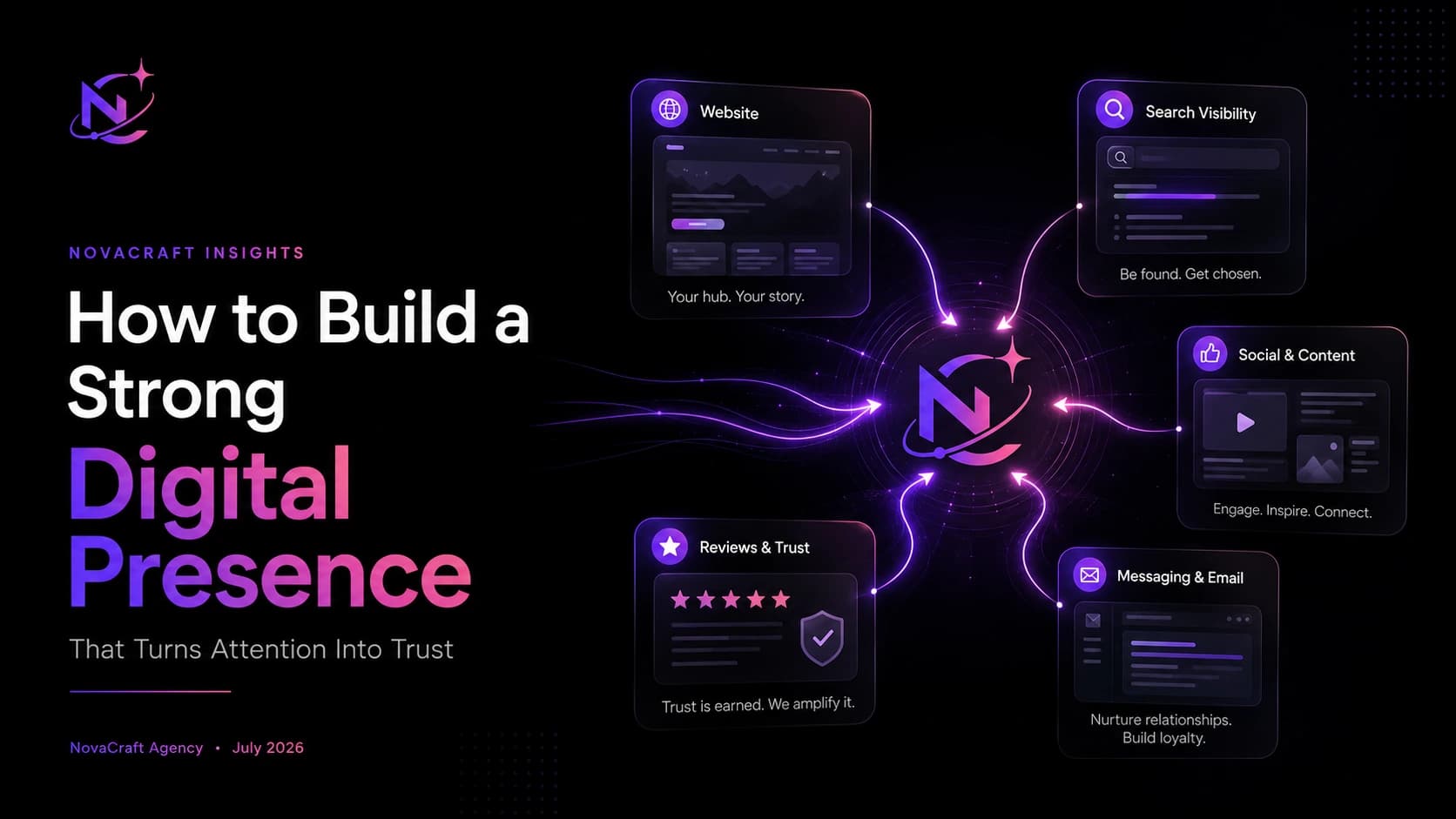
Most businesses are visible online. Far fewer are clear, credible, and memorable.
A company may have a website, an Instagram page, a LinkedIn profile, and a Google Business listing, yet still leave potential customers unsure about what it does, who it helps, or why it should be trusted. The problem is not always a lack of activity. Often, it is a lack of connection between the pieces.
A strong digital presence brings those pieces together. It gives people a consistent experience wherever they find you and makes the next step feel natural.
This guide explains how to build a strong digital presence that supports visibility, trust, and business growth without trying to be everywhere at once.
What does “digital presence” actually mean?
Your digital presence is the complete impression your business creates online. It includes the channels you own, the platforms where you participate, and the conversations happening around your name.
That can include:
- your website and landing pages
- search engine results and business listings
- social media profiles and content
- reviews, testimonials, and third-party mentions
- email communication and lead follow-up
- online advertising and campaign pages
- the speed, usability, and consistency of every digital interaction
A website is therefore part of your digital presence, not the whole of it. The same is true for social media. Each touchpoint should support one recognisable story about your business.
Why a strong digital presence matters
People rarely form an opinion about a business from one interaction. They may discover a post, search the company name, visit the website, compare services, read reviews, and return several days later.
At every stage, they are looking for small signals. Is the offer clear? Does the business look active? Do the details match across platforms? Does the experience feel professional? Can they find proof that the company delivers what it promises?
When those signals support one another, trust grows. When they conflict, even a good service can become harder to choose.
Seven foundations of a strong digital presence
1. Start with clear positioning
Before choosing channels or publishing content, define what you want to be known for. A useful positioning statement should make three things easy to understand: who you help, what problem you solve, and what makes your approach relevant.
Avoid trying to sound impressive at the cost of clarity. Phrases such as “innovative solutions” or “end-to-end excellence” say very little unless they are supported by a specific outcome. Plain language is usually more persuasive.
If a potential customer cannot explain your business after a short visit, the message needs more focus.
2. Treat your website as the centre of the experience
Social platforms can introduce your brand, but your website gives you control over the full story. It should help visitors understand the offer, evaluate credibility, and take the next step without unnecessary effort.
A useful website should answer these questions quickly:
- What does this business do?
- Who is it for?
- What problem does it solve?
- What proof supports its claims?
- What should I do next?
Good visual design matters, but design should make the message easier to understand. Strong hierarchy, readable typography, thoughtful mobile layouts, fast loading, and obvious calls to action all contribute to trust. This is the ground our website design and development work is built on.
3. Build search visibility around real customer questions
Search visibility does not begin with repeating broad keywords. It begins with understanding what potential customers are trying to learn, compare, or solve.
A smaller business can often create more useful content by focusing on specific questions rather than chasing the most competitive terms. A detailed article that addresses a clear problem can attract a more relevant visitor than a generic post built around a high-volume phrase.
For example, content could address:
- how to choose the right website development partner
- what a small business should include on a service page
- how long SEO takes to show meaningful progress
- when a brand needs a redesign rather than a complete rebrand
Create each page for a defined purpose. Use a descriptive title, one clear main heading, useful subheadings, natural internal links, and a concise summary for search results. Most importantly, answer the question thoroughly. That approach is what our SEO services are organised around.
4. Make every channel feel like the same brand
Consistency does not mean copying the same post everywhere. It means the brand remains recognisable even when the format changes.
Your website may be more detailed, Instagram more visual, LinkedIn more reflective, and email more direct. The tone, promise, visual identity, and standard of communication should still feel connected.
Review your logo usage, colour palette, typography, profile descriptions, service names, contact details, and calls to action across platforms. Small inconsistencies can make an active business look less established than it is. Our branding and visual identity work exists to keep those details aligned.
5. Publish content with a defined role
Content should do more than keep a page active. Every piece should help the audience understand, evaluate, remember, or act.
A balanced content system can include:
- educational content that answers common questions
- perspective-led content that shows how the business thinks
- proof content such as case studies, outcomes, and testimonials
- service content that explains what is offered and who it suits
- human content that shows the people and process behind the work
Not every post needs a hard sell. Useful content earns attention over time, while proof and service content help turn that attention into a serious enquiry. Where distribution is the constraint, social media and marketing support is usually the missing piece.
6. Use proof to reduce uncertainty
Customers do not only assess what you say about your business. They look for evidence that other people have trusted you.
Strong proof can include detailed testimonials, project outcomes, before-and-after examples, screenshots, process explanations, client logos used with permission, and case studies that show the challenge, approach, and result. You can see how we present ours on our work.
If an NDA prevents you from naming a client or sharing confidential work, you can still describe the industry, problem, constraints, and measurable outcome at an appropriate level. The goal is to demonstrate how you think and work without exposing protected information. For the specific building blocks that build this kind of confidence, see our guide on what makes a business website trustworthy.
7. Measure what happens after attention
Reach and impressions can be useful, but they do not explain whether your digital presence is helping the business.
Track signals that connect activity with intent, such as:
- qualified website enquiries
- conversion rate on important landing pages
- organic visits to service and insight pages
- branded search growth
- discovery-call bookings
- email sign-ups or resource downloads
- returning visitors and assisted conversions
The purpose of measurement is not to collect more dashboards. It is to identify where people lose confidence, where they hesitate, and which messages or channels help them move forward.
Common mistakes that weaken an online presence
Businesses often invest in individual assets without building the system that connects them. Watch for these common problems:
- Trying to be active on every platform without the capacity to maintain quality.
- Using different service descriptions, visual styles, or contact details across channels.
- Building a polished website around vague messaging.
- Publishing content without a clear audience or purpose.
- Prioritising traffic while ignoring trust, usability, and conversion.
- Making large claims without visible proof.
- Treating launch day as the end of the work.
A strong digital presence develops through regular review. The market changes, customer questions change, and the business itself becomes clearer. Your digital system should evolve with it.
A practical 30-day starting plan
- Audit your current presence. Search your business name, review every active profile, test the website on mobile, and note where information or visuals do not match.
- Clarify the core message. Write one clear description of who you help, what you provide, and why it matters. Use it as the reference point for every channel.
- Fix the highest-trust pages first. Improve the homepage, core service pages, about page, contact journey, and proof sections before adding more content.
- Choose two priority channels. Focus on the places your audience already uses and where your team can maintain a consistent standard.
- Publish one genuinely useful resource. Answer a specific customer question in enough detail that the reader can make a better decision.
- Set a simple measurement baseline. Record current search traffic, enquiries, conversion rate, and branded search activity so future progress has context.
Build a connected system, not a collection of profiles
The strongest digital presence is not necessarily the loudest. It is the one that feels clear wherever a customer encounters it.
Your website, search visibility, content, social channels, proof, and follow-up should work together. When they do, people spend less time trying to understand the business and more time deciding whether it is the right fit.
That is where digital strategy becomes valuable. It turns separate activities into a connected experience built around trust, relevance, and action.
Frequently asked questions
A website is one channel owned by a business. A digital presence is the broader impression created by the website, search results, social profiles, reviews, content, ads, email, and third-party mentions.
Core improvements can begin within a few weeks, but credibility and organic visibility develop over time. The timeline depends on the starting point, market competition, content quality, technical condition of the website, and consistency of execution.
No. It is usually better to maintain a strong presence on a few relevant channels than a weak presence on many. Choose platforms based on audience behaviour, content fit, and your ability to stay consistent.
Start with clarity and trust. Make the offer easy to understand, ensure contact information is accurate, improve important website journeys, add credible proof, and align the brand across active channels.
Want a second opinion on your digital presence?
Tell us where things stand today. We will tell you honestly what is working, what is not, and what we would do first.