
Website Strategy
How to Choose the Right Website Design and Development Partner
Learn how to evaluate a website design and development partner across strategy, process, technology, communication, ownership, testing, and long-term support.
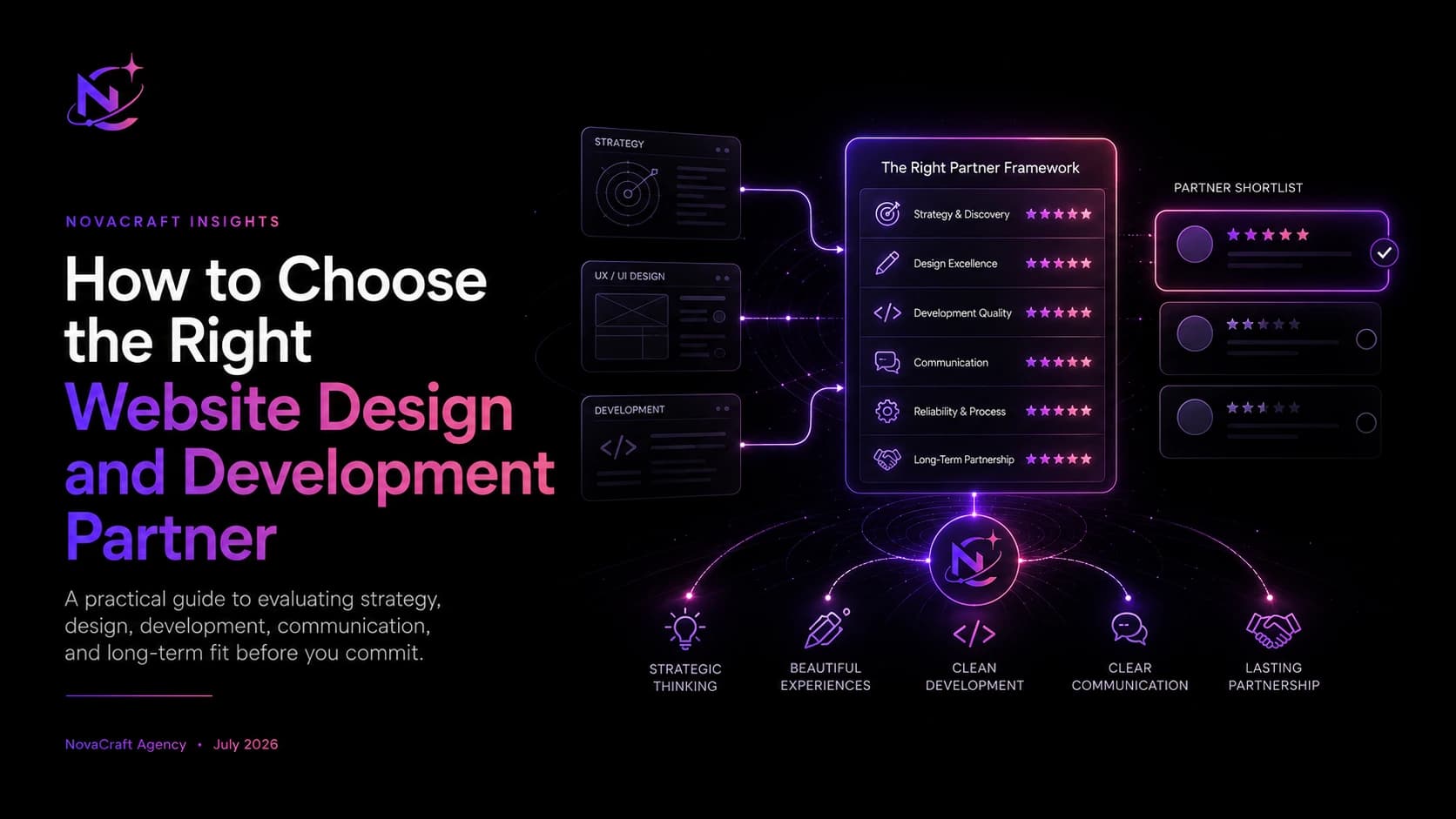
Choosing a website partner is not simply a design decision. It is a business decision that can influence how customers understand your company, how easily your team manages content, and how well the website supports growth after launch.
A polished portfolio may help you create a shortlist, but it does not tell you how an agency thinks, communicates, handles risk, or makes technical decisions. Those details often determine whether a project becomes a useful business asset or an expensive source of frustration.
If you are learning how to choose a website development partner, the goal is not to find the agency with the longest service list. It is to find a team that understands the problem, can explain its process clearly, and has the right capabilities for your project.
This guide walks through the areas worth evaluating before you sign a proposal.
Start with the business problem, not the list of features
Before comparing agencies, define what the website needs to change for the business. A requirement such as “we need a modern website” is too broad to guide good decisions. Modern can refer to appearance, technology, content, speed, usability, or all of them.
A stronger brief connects the project to a specific need. For example:
- the current website attracts traffic but produces few qualified enquiries
- the brand has changed and the website no longer represents the business
- the sales team needs clearer service pages and stronger proof
- the internal team cannot update content without developer support
- the website is slow, difficult to use on mobile, or technically outdated
- the business is entering a new market and needs a scalable content structure
You do not need to arrive with a complete specification. A capable partner should help shape it. You should, however, be clear about the business context, the people the website serves, the problems you already know about, and the result you hope to improve. If you already suspect the answer is a rebuild rather than a redesign, our guide on website redesign vs rebuild explains how to tell the difference.
What should a website design and development partner actually do?
The exact responsibilities depend on the project, but a strong partner connects several disciplines rather than treating them as isolated tasks.
- Discovery and strategy: understanding the business, audience, competition, goals, constraints, and success measures.
- Information architecture: deciding how pages, content, and user journeys should be organised.
- UX and UI design: making the experience intuitive, accessible, visually consistent, and appropriate for the brand.
- Content direction: helping determine what each page needs to communicate, even when final copywriting is handled separately.
- Development: building a secure, maintainable, responsive website using technology suited to the actual requirements.
- SEO foundations: preserving crawlability, metadata control, redirects, structured content, and performance during launch.
- Quality assurance: testing across devices, browsers, forms, integrations, accessibility considerations, and real user journeys.
- Launch and support: managing deployment, training, documentation, monitoring, fixes, and agreed post-launch improvements.
Not every agency provides all of these services in-house, and that is not automatically a problem. What matters is that ownership is clear. You should know who is responsible for each part and how those people work together.
Ten factors to evaluate before choosing a partner
1. Do they ask thoughtful questions?
The first conversation reveals a great deal. A team that immediately recommends a platform, page count, or visual direction may be moving too quickly.
Look for questions about customers, sales journeys, current analytics, content ownership, internal workflows, integrations, competitors, accessibility, search visibility, and what success should look like after launch. Thoughtful questions are evidence that the agency is diagnosing the project rather than fitting it into a standard package.
2. Can they connect design decisions to business goals?
Good design is not decoration. It should improve clarity, guide attention, support trust, and help people complete important actions.
When reviewing a proposal or portfolio, ask why particular choices were made. A strong partner should be able to explain how navigation, hierarchy, content, interaction, and calls to action support the intended user journey. If every explanation comes back to trends or personal taste, the decision-making may lack depth.
3. Is the portfolio relevant, and is the thinking visible?
Visual quality matters, but relevance matters more. An agency does not need to have built a website for an identical company, yet it should be able to show work with comparable complexity, audience needs, integrations, or commercial goals.
Look beyond screenshots. Ask what problem the project addressed, what constraints shaped the solution, what the team owned, and what changed after launch. If some work is protected by an NDA, the agency may not be able to name the client or share source files. It should still be able to describe its role and process without revealing confidential information.
4. Does the process have clear stages and decisions?
A reliable process does not need to be complicated. It should show how the project moves from discovery to structure, design, development, testing, launch, and support.
You should understand what is delivered at each stage, who approves it, how feedback is collected, and what happens when a decision changes. Clear checkpoints prevent a project from reaching development with unresolved content or design questions.
5. Is the technical approach appropriate for your needs?
The most familiar or fashionable technology is not always the right one. The platform should reflect the website’s content, integrations, performance expectations, internal skills, security needs, and future plans.
Ask the team to explain its recommendation in plain language. Who will host the website? Who owns the accounts and source code? Can your team edit content? How are backups, updates, security, analytics, consent tools, and third-party services handled? What happens if you work with another developer later?
You do not need to become a developer to assess the answer. You need enough clarity to understand the trade-offs and avoid unnecessary dependency. This is exactly the kind of decision our web design and development work is built to walk you through.
6. Do they treat performance, accessibility, and SEO as build requirements?
These areas should not appear for the first time at the end of the project. Page speed, responsive behaviour, semantic structure, keyboard use, readable contrast, image handling, redirects, metadata, crawlability, and analytics all influence the quality of the finished website.
Google’s current Core Web Vitals use Largest Contentful Paint, Interaction to Next Paint, and Cumulative Layout Shift to assess loading, responsiveness, and visual stability. WCAG 2.2 provides an internationally recognised standard for web accessibility. A partner should be able to describe how these considerations are included in design, development, and testing rather than offered only as vague assurances.
7. Is communication structured and honest?
Projects rarely fail because of one dramatic mistake. More often, small decisions remain unclear until they become delays.
Confirm who your main contact will be, how often updates are shared, which collaboration tools are used, and how risks are raised. The best answer is not “everything will go perfectly.” It is a communication system that makes progress, blockers, decisions, and responsibilities visible.
Pay attention to whether the team can explain complex matters without hiding behind jargon. Clear communication before the contract is usually a good indication of what collaboration will feel like later.
8. Is the proposal specific about scope, assumptions, and exclusions?
A useful proposal should do more than state a price. It should define the project objectives, deliverables, stages, responsibilities, estimated timeline, payment schedule, revision approach, dependencies, and what is not included.
Check assumptions about content, photography, copywriting, data migration, translations, integrations, legal pages, hosting, premium plugins, third-party subscriptions, SEO migration, and ongoing support. Ambiguity in these areas often becomes an unexpected cost.
9. Is the price tied to a credible plan?
The lowest quote is not always the least expensive option. A proposal can appear affordable because discovery, content support, testing, migration, or post-launch work has been excluded.
Compare the thinking and responsibilities behind each estimate, not only the final number. Ask what could change the price, how additional work is approved, and whether third-party costs are included. A credible partner should be comfortable explaining where the budget goes.
10. What happens after the website goes live?
Launch is a transition, not the end of the project. Websites need monitoring, updates, content improvements, performance reviews, security maintenance, and occasional technical support.
Clarify the warranty or defect period, support response times, maintenance options, training, documentation, ownership transfer, and how future improvements are prioritised. Even if you do not purchase ongoing support, you should leave with the access and knowledge needed to operate the website responsibly.
Questions to ask a web development agency
Use these questions during your shortlist conversations. You do not need to ask every one in a single meeting, but the answers should be clear before work begins.
- How will you learn about our business, customers, and current website performance?
- Who will work on our project, and which work is completed by external specialists?
- What will we review and approve before development begins?
- Why do you recommend this platform or technical approach?
- How will the website be tested for mobile use, accessibility, speed, forms, and browser compatibility?
- How will you protect existing search visibility and manage redirects during launch?
- What do you need from our team, and when will you need it?
- How are revisions, delays, and changes in scope handled?
- Which accounts, licences, source files, design files, and data will we own?
- What support, training, and documentation are included after launch?
- How will we measure whether the website is achieving its intended goals?
Red flags worth taking seriously
- A fixed solution is recommended before the agency understands the requirements.
- The proposal uses broad promises but leaves deliverables and responsibilities unclear.
- The portfolio is attractive, but the team cannot explain its role or the reasoning behind the work.
- Performance, accessibility, SEO migration, security, or quality assurance are dismissed as optional details.
- You cannot identify who owns hosting accounts, analytics, domains, licences, source code, or design files.
- The timeline depends on immediate approvals but your responsibilities and review windows are not documented.
- Communication is slow or confusing during the sales process.
- The team promises guaranteed search rankings or specific business results it cannot control.
One concern may have a reasonable explanation. Several unresolved concerns usually point to a poor fit. It is better to slow down during selection than to discover the gaps after design or development has begun.
A simple website agency selection checklist
- Define the outcome. Write down the business problem, priority audiences, essential functionality, known constraints, target timeline, and realistic budget range.
- Create a focused shortlist. Choose agencies whose capabilities and project scale are relevant. Avoid sending the same vague request to a large number of suppliers.
- Share the same context. Give each shortlisted partner enough information to understand the project so their recommendations can be compared fairly.
- Evaluate the conversation. Score the quality of discovery, clarity of communication, relevant experience, strategic thinking, technical reasoning, and cultural fit.
- Compare proposals by scope. Review what is included, excluded, assumed, and dependent on your team. Separate one-time project costs from ongoing costs.
- Check references where appropriate. Ask past clients about communication, reliability, problem-solving, budget control, launch quality, and support.
- Confirm ownership and handover. Put account access, intellectual property, files, credentials, training, and documentation in writing.
- Choose a working relationship. Select the team you trust to make decisions with you, raise concerns early, and remain accountable when the work becomes complex.
Choosing the right partner is about confidence, not certainty
No selection process can remove every risk. Website projects involve changing information, technical dependencies, stakeholder feedback, and decisions that become clearer as the work progresses.
The purpose of careful evaluation is to choose a partner whose process makes those uncertainties manageable. The right team will not simply agree with every request. They will ask useful questions, explain trade-offs, protect the project from avoidable mistakes, and keep the work connected to its original purpose.
When strategy, design, development, and communication work together, the website is more likely to become something the business can use, measure, maintain, and improve.
Frequently asked questions
Start by defining the business outcome and essential requirements. Then evaluate each partner’s discovery process, relevant work, strategic thinking, technical approach, communication, proposal clarity, ownership terms, and post-launch support. Choose the team whose reasoning and working process give you confidence, not simply the lowest quote.
Look for a clear process, relevant capabilities, thoughtful questions, accessible communication, appropriate technology recommendations, strong testing practices, transparent pricing, and clear ownership of files and accounts. The company should also explain how it handles performance, accessibility, SEO foundations, security, and support.
For many projects, three to five carefully selected partners provide enough comparison without making the process unmanageable. A smaller, relevant shortlist usually leads to better conversations than requesting generic proposals from many agencies.
The right choice depends on scope, complexity, budget, timeline, and the range of skills required. A freelancer may suit a focused project with limited dependencies. An agency may be a better fit when strategy, UX, visual design, development, content, SEO, testing, and ongoing support need coordinated ownership.
Industry experience can shorten the learning curve, but it should not be the only criterion. Experience with similar users, business models, technical complexity, compliance needs, or conversion journeys may be equally valuable. The team’s ability to learn and ask informed questions matters.
A proposal should normally cover objectives, deliverables, process, timeline, team, client responsibilities, revision rules, technology, testing, launch, support, fees, payment terms, assumptions, exclusions, change control, ownership, and relevant third-party costs.
Want a second opinion on your digital presence?
Tell us where things stand today. We will tell you honestly what is working, what is not, and what we would do first.